The manufacturing gap
Africa’s share of value generated in clean-energy technology and component manufacturing, as described by IEA in 2025.
 RAKUROYAL AFRICAN KINGDOMS UNION
RAKU Reports · The royal knowledge collection
Research that connects Africa’s resources, people and possibilities with a more prosperous future.
Explore our latest report ↓Browse the collection ↗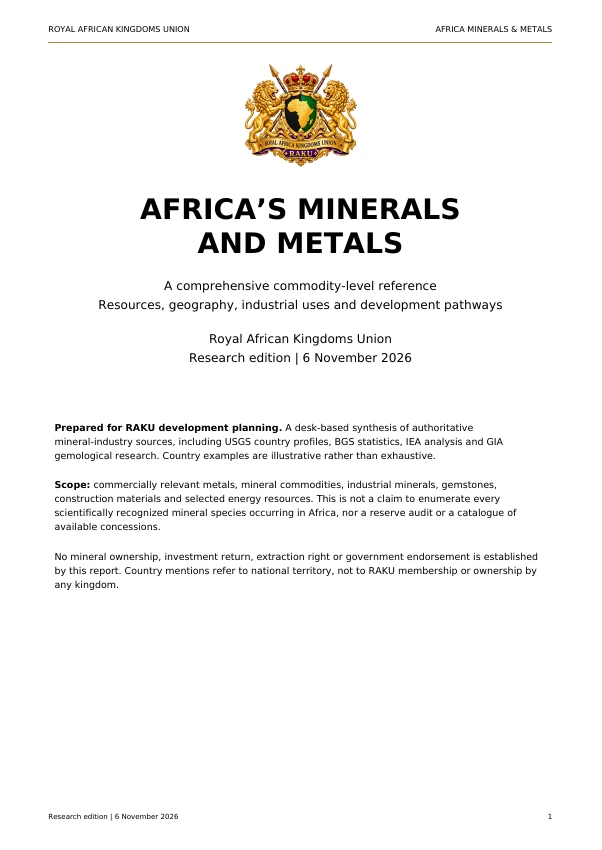 Latest research · 18 pages · PDF ↗
Latest report · 6 November 2026
A continent of resources. A future built on value.
Explore precious and base metals, battery minerals, industrial materials, gemstones and energy resources through a comprehensive commodity-level directory. The report connects African examples with industrial uses, evidence qualifications and development pathways.
This is a practical reference for kingdoms, institutions and prospective partners seeking to understand Africa’s mineral opportunity and the work required to turn potential into productive enterprise.
Read the full report ↗Download PDF ↓18 pages · Source references included · Research edition
Africa’s strategic mineral wealth
Africa’s mineral endowment spans the inputs needed for industry, food systems, infrastructure and modern technology. Its significance comes from the diversity of those resources and their role in global supply chains. The task is to convert geological potential into viable projects, skilled employment and lasting local value.
Approximate shares of global unprocessed supply reported by IEA in 2025. Each bar refers to a different commodity.
Source: IEA, Stepping Up the Value Chain in Africa (2025). Supply shares are not reserve shares and cannot be added together.
Morocco’s reported share of world phosphate-rock reserves · 2024 context · USGS
50 billion metric tons
Phosphate-rock reserves reported by USGS
Source: USGS Morocco profile, 2024 reporting context. A commodity-specific reserve estimate, not Africa’s total mineral wealth or a dollar valuation.
Africa’s share of value generated in clean-energy technology and component manufacturing, as described by IEA in 2025.
IEA’s High Potential Case for the market value of minerals in Africa. This is a modeled outcome, not an in-ground valuation or promised revenue.
Both indicators: IEA (2025), linked above. Different metrics and reference periods; figures are not additive.
Mineralization is present. Its extent, grade and economic value may remain unknown.
Geological evidence supports an estimate under stated reporting assumptions.
A mineable portion is supported by economic and other modifying factors.
A project produces a saleable product after costs, recovery, permissions and market requirements.
There is no single verified total dollar valuation of Africa’s underground assets established by this report. Geological quantities multiplied by commodity prices do not equal recoverable profit, public revenue or investable value. Ownership and lawful mineral rights must be verified separately.
From knowledge to productive opportunity
Match beneficiation and refining to independent testwork, reliable energy, water and real customer requirements.
Connect technical training, laboratories, engineering and local suppliers to the needs of viable projects.
Limestone, aggregates, clay and industrial minerals can support housing, agriculture and local enterprise alongside globally traded metals.
Build opportunity registers around technical information, clear rights, credible operating plans and measurable community outcomes.
The royal collection
6 November 2026 · 18 pages
Mineral commodities, country examples, industrial uses and development pathways.
Read report ↗Download PDF ↓
RAKU research briefing
Population and development indicators for informed planning.
Read report ↗Download PDF ↓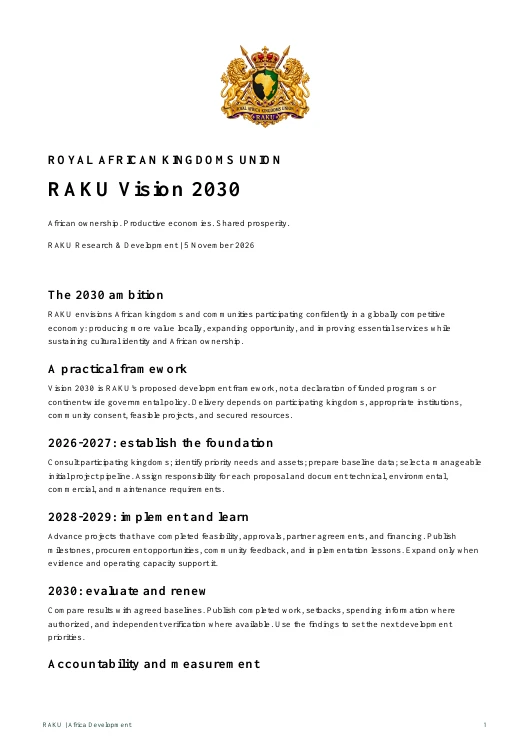
Development framework
The Union’s proposed priorities for opportunity, cooperation and shared prosperity.
Read report ↗Download PDF ↓
Planning resource
Evidence, delivery principles and open-data resources for project preparation.
Read report ↗Download PDF ↓Royal Reports are RAKU research syntheses. Original sources retain their authorship and do not imply endorsement of the Union. The featured report draws on USGS, BGS, IEA, GIA and geological-survey materials. Statistics are dated snapshots, and country examples do not establish RAKU membership or mineral ownership.
Explore sources and methodology ↗Discuss a research partnership ↗